Surprising claim to start: the single biggest security improvement a wallet can offer for active DeFi users is not multi-sig support or hardware integration per se, but reliable pre-signature visibility — the ability to know precisely what a transaction will do before your private key touches it. Rabby Wallet places that mechanism at the center of its value proposition: pre-transaction risk scanning plus transaction simulation. For traders, liquidity providers, and protocol arbitrageurs in the US market who move large sums across chains and chains’ bridges, that combination changes the error taxonomy from “blind mistakes” to “judgment calls.”
This article walks through how Rabby implements those mechanisms, what trade-offs it imposes, where it meaningfully reduces risk, and where it still falls short for an institutionally minded DeFi operator. I’ll compare Rabby to two familiar alternatives (MetaMask and a custodial mobile wallet), explain the boundary conditions where Rabby’s protections stop, and offer practical heuristics you can reuse when choosing or configuring a wallet for heavy DeFi use.
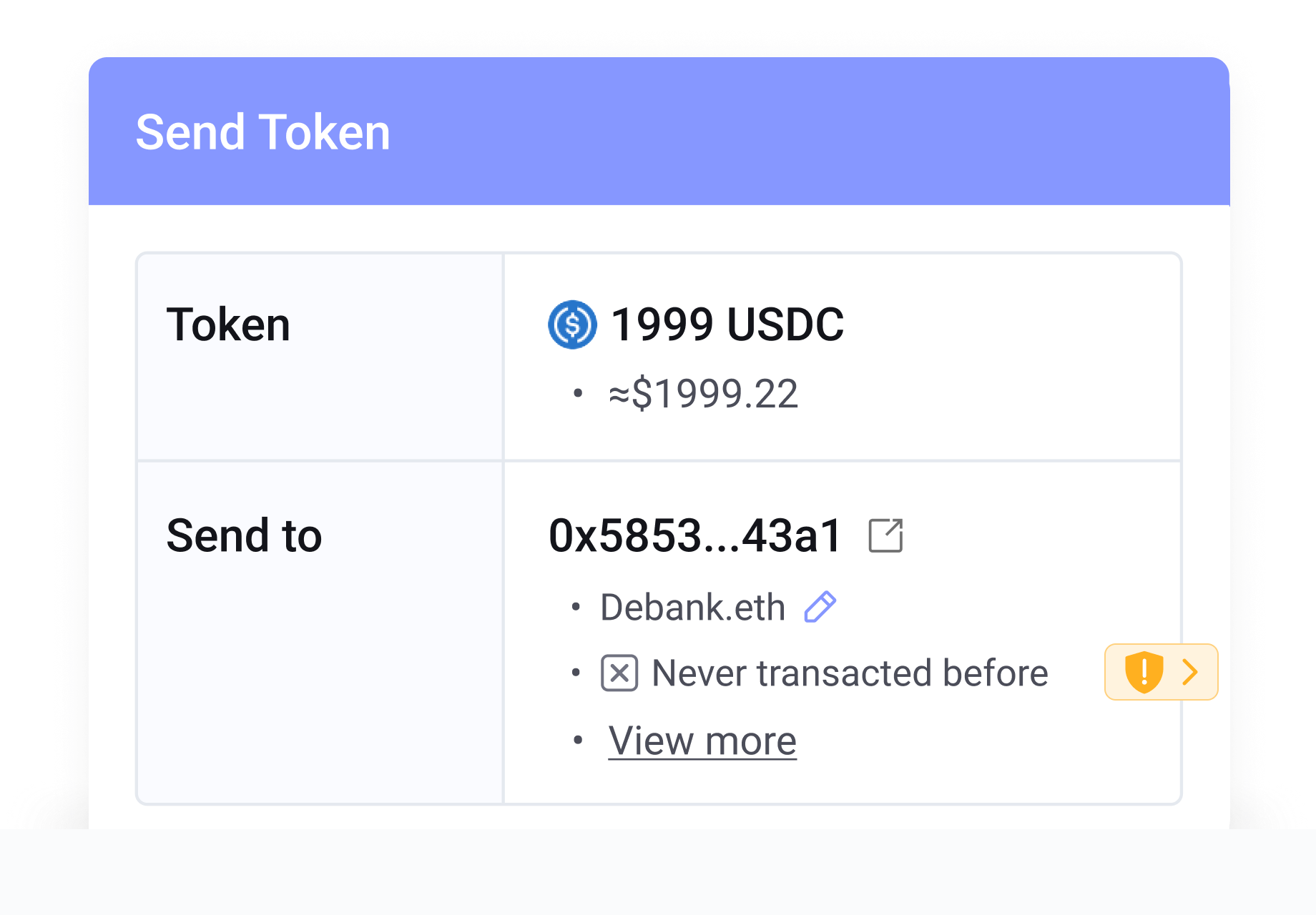
Mechanism first: how Rabby’s transaction simulation and risk scanning work in practice
At the technical level, Rabby takes a proposed transaction, runs a local or proxied dry-run against a node (or a suite of indexed sources), and computes the expected token balance deltas and gas costs. It then overlays a ruleset that screens for known bad patterns — previously exploited contracts, unusually broad ERC-20 approvals, transfers to non-existent addresses, or anomalous parameter values. The result is a human-readable summary: “If you sign this, token X will drop by Y, you’ll pay Z gas, and contract C has prior incidents.”
Why that matters: most wallet failures happen during the signing step when users can no longer see the downstream effects of a call (so-called blind signing). By surfacing balance changes and approval scopes, transaction simulation converts cryptic calldata into an interpretable outcome. For power users executing batched actions, this turns an abstract risk into a concrete number and lets you decide whether a trade, approval, or contract interaction is acceptable.
Trade-offs and limits: what simulation stops — and what it can’t
Important boundary condition: simulation is only as good as the model and the data. Rabby’s engine can flag known exploited contracts and suspicious approvals, but it cannot predict zero-day backdoors in a novel contract or off-chain governance changes that later alter contract behavior. Similarly, simulation shows estimated token deltas but cannot guarantee finality under front-running, MEV (miner/extractor value) reordering, or chain congestion that changes effective slippage and gas behavior at the moment of inclusion.
Another trade-off is latency and UX: detailed pre-checks introduce additional latency and a denser signing UI. For high-frequency strategies where nanoseconds matter, that trade-off may be unacceptable. For tactical traders or manual LP managers, the friction is a net gain. Also note functional limitations: Rabby currently lacks an in-wallet fiat on-ramp and native staking flows, so it is not a one-stop consumer app for acquiring or staking crypto without external services.
Where Rabby fits in the wallet spectrum: comparison and recommended roles
Compare three archetypes for a US-based DeFi operator:
– Rabby (non-custodial, simulation-first) — Strengths: transaction simulation, approval revocation, automatic network switching across 90+ EVM chains, hardware wallet compatibility, and integrations with multi-sig and custody platforms (Gnosis Safe, Fireblocks). Weaknesses: no fiat on-ramp, no native staking UI; simulation cannot eliminate all smart-contract risk.
– MetaMask (ubiquitous extension) — Strengths: massive dApp compatibility, widespread developer assumptions. Weaknesses: historically simpler signing UI and fewer built-in pre-sign safety checks; users often need add-ons to reach Rabby’s level of pre-checking.
– Custodial mobile wallet (exchange custody) — Strengths: integrated fiat on-ramps, institutional custody options. Weaknesses: counterparty risk, less transparency, and limited direct multi-chain smart contract interaction options for sophisticated DeFi strategies.
Decision rule: if you execute complex smart-contract interactions across chains and value actionable pre-sign information more than minimal latency, select a simulation-first wallet like Rabby and pair it with a hardware wallet or multi-sig for key custody. If your primary need is fiat access and rapid consumer onboarding, a custodial route or another mobile wallet may be acceptable, but you trade off the transparency Rabby provides.
Operational recommendations and configuration heuristics
Practical set-up for a US-based DeFi power user:
1) Use Rabby as a primary extension on a Chromium browser (Chrome, Brave, Edge) and enable the ‘Flip’ toggle if you routinely switch between MetaMask and Rabby sessions. The flip allows rapid testing without permanent profile changes.
2) Connect a hardware wallet (Ledger, Trezor, Keystone) for signing high-value transactions. Rabby’s hardware compatibility reduces key-exposure risk while preserving simulation visibility.
3) Configure approval revocation as a routine. Before entering new liquidity pools or AMMs, run Rabby’s approval scanner and revoke permissive approvals you no longer need. That reduces ongoing exposure from token approvals — a common vector in DeFi exploits.
4) Treat simulation outputs as decision inputs, not guarantees. If a simulation flags a contract with prior incidents, escalate: inspect the contract source, check multisig ownership, or test with a minimal-value transaction first.
Security history and what it signals
Contextual limitation: Rabby’s ecosystem experienced a Rabby Swap contract exploit in 2022 (~$190k). The team’s response — freezing the contract, compensating users, and increasing audits — is consistent with industry best practices after an incident, but it is a useful reminder that tooling reduces but cannot eliminate systemic smart-contract risk. Audits and open-source transparency (MIT license) improve the chance of independent review, yet open-source software can still contain exploitable logic if assumptions or integrations change.
One implication for US-based teams: regulatory and compliance pressure is increasing on custody, KYC, and money services. Using a non-custodial wallet like Rabby minimizes custody obligations but does not exempt you from compliance duties when interfacing with fiat rails or institutional services. Pair Rabby with institutional-grade custody providers (Gnosis Safe, Fireblocks) when regulatory constraints require multi-sig or insured custody.
What to watch next (conditional signals)
Look for these signals to decide whether Rabby’s model is gaining or losing comparative advantage:
– Broader adoption of pre-sign simulation as a standard across wallets; if it becomes ubiquitous, Rabby’s uniqueness diminishes and competition focuses on UX and integrations.
– Improved on-chain anti-MEV tools and private relay adoption; these will change the effectiveness of pre-sign simulations in real-world inclusion outcomes.
– Regulatory guidance on browser extensions and non-custodial wallets in the US; harder rules on custody or fiat flows could push wallets to add custodial layers or partner with regulated entities.
FAQ
Q: Can Rabby prevent all smart-contract exploits?
A: No. Rabby’s simulation and pre-transaction scanning materially reduce the chance of blind-signing errors and alert users to known issues, but they cannot prevent zero-day contract bugs, off-chain governance changes, or some classes of MEV attacks. Treat simulation outputs as high-quality risk signals, not absolute guarantees.
Q: How does Rabby compare to MetaMask for heavy DeFi use?
A: Mechanistically, Rabby’s edge is pre-sign simulation, approval revocation, and automatic network switching across 90+ EVM chains. MetaMask remains the most widely supported wallet in dApp UX flows, but Rabby reduces operational risk for complex interactions. The pragmatic approach is to use Rabby with a hardware wallet for high-value or multi-step operations, while keeping MetaMask available for compatibility testing.
Q: Is Rabby suitable for institutional deployment?
A: Yes, with conditions. Rabby integrates with institutional tools—Gnosis Safe, Fireblocks, Amber, Cobo—but institutional deployments should couple Rabby’s UI and simulation features with hardened custody and internal controls: policy-based multi-sig thresholds, transaction approval workflows, and monitoring. Rabby’s open-source code and integrations make it practical for institutional stacks, but governance and compliance remain the institution’s responsibility.
If you want to test the wallet’s signing UX and inspect its simulation outputs directly, the team provides a downloadable extension and clients. For a focused way to evaluate the experience, try the extension, connect a read-only hardware wallet session, and run a few low-value simulated trades to compare the detail and clarity of the pre-sign summaries. For quick access, consider this page on rabby wallet.
Final practical takeaway: in a threat environment where smart-contract complexity and cross-chain activity increase, prioritize tools that convert opaque calldata into concrete, comparable outcomes before signing. Rabby’s design explicitly pursues that conversion; it’s not a panacea, but for many DeFi power users in the US it represents a meaningful shift from blind trust to informed choice.